
Document Verification and Control
See how third-party document control is evolving in organizations with AI agents.
- Prebuilt agent Ready to use, we do not start from scratch.We start from an agent prepared for this process and configure it with your rules, your systems and your way of working.
- Best practices Built in from day one.The agent's instructions incorporate the process practices we have applied when automating it in different organizations.
- Configured by experts Functional and technology consultants.Specialized consultants support the configuration, integration, testing and go-live of the agent in your operation.
- Agent platform Workforce AI.The agent runs on Workforce AI, GIITIC's own platform that centralizes security, permissions, audit, usage and administration of all your agents.
- Process experience Processes + technology + enterprise software.Behind every agent are years of experience implementing enterprise software and automating processes in companies across Latin America.
- GIITIC software ecosystem The tools the agent needs.We integrate with your current systems and, if you are missing one, the GIITIC ecosystem provides the modules the agent needs to query and act.

How it is done today, and why it is no longer enough
Non-compliance is costly: according to the ACFE’s 2026 report, covering 2,402 cases from 143 countries, organizations lose about 5% of their annual revenue to internal fraud.
- Unclear requirements
- Endless follow-up
- Manual review
- Questionable documents
- Unmonitored expirations
- Scattered evidence
Document Verification and Control agent

I'm an artificial intelligence agent trained by experts, ready to use and built with best practices. I am here to manage the documentation of your customers, suppliers, employees and contractors: I determine which documents each one must provide, request them and follow up, interpret their content, verify their authenticity with the available mechanisms, apply your policies and monitor their validity. I handle what is missing or expiring and escalate what requires judgment.
Prebuilt, but adaptable to each organization.
How I work
- I detectRequired documentsI identify the documents each third party must provide based on its type, country, activity, risk and contract.
- I requestRequests and follow-upI ask for what is missing by email, WhatsApp or portal, with a secure link, and understand every reply.
- I understandDocument readingI recognize the document type and extract names, IDs, dates and issuers, even from scans.
- I analyzeValidity and complianceI compare the data with your ERP or CRM, your policies and authorized official sources.
- I decideExceptionsI separate what complies from what is incomplete, questionable or expired, propose actions and escalate what requires judgment.
- I monitorValidityI calculate expiration dates and maximum ages and request renewals in advance.
- I recordEvidenceI keep versions, validations, requests and approvals to demonstrate compliance.
Results you can achieve
- in losses with proactive data monitoring
- −50%Proactive data monitoring and analysis was associated with at least half the loss and duration of fraud.Source: ACFE, 2024
- greater loss when fraud is detected late
- 27×The median loss goes from 40,000 dollars, if detected in under six months, to more than 1.1 million after five years.Source: ACFE, 2026
- higher cost of non-compliance than compliance
- 2.71×Average annual cost of non-compliance versus compliance in data protection.Source: Ponemon Institute (sponsored by Globalscape), 2017
Reference values based on benchmarks and comparable scenarios. Results depend on the characteristics of each operation and are not guaranteed results.
Greater speed, higher quality, lower costs

Greater speed
Automate tasks and connect your information so your team responds sooner and your processes move forward without waiting.
- Requests documents as soon as the third party is registered
- Reads and validates each document in minutes, as soon as it arrives
- Follows up without waiting for someone to remember
- Requests renewals before documents expire

Higher quality
Standardize the work and control every step so your information is reliable and your results are consistent.
- Asks each third party for the requirements that match its profile
- Detects illegible, wrong, incomplete or inconsistent documents
- Flags signs of tampering or impersonation
- Leaves evidence of every version, validation and approval

Lower costs
Reduce rework, errors and manual work so your operation delivers more with the same resources.
- Reduces hours spent requesting, following up and reviewing manually
- Avoids working with third parties whose documents are expired or invalid
- Reduces the risk of fines, penalties and fraud
- Better prepares internal and external audits
Artificial intelligence in third-party document control
Before
- 8:00 a.m.8:00 a.m. · MilestoneA new services supplier is registered in the ERP
- 8:00 a.m.8:00 a.m. · PersonThe analyst checks the policy and builds the list of documents for its profile20 min
- 8:20 a.m.8:20 a.m. · PersonWrites to the supplier to request the seven documents10 min
- 8:30 a.m.8:30 a.m. · Lost timeWaits for the supplier to send the documents48 h
- 8:30 a.m. · day 38:30 a.m. · day 3 · PersonReviews the documents one by one: the bank certificate doesn’t match the tax ID and the insurance policy is missing1 h 30 min
- 10:00 a.m. · day 310:00 a.m. · day 3 · PersonWrites to the supplier to request the correction10 min
- 10:10 a.m. · day 310:10 a.m. · day 3 · Lost timeWaits for the corrected documents24 h
- 10:10 a.m. · day 410:10 a.m. · day 4 · PersonReviews the corrected documents and records the validation in a spreadsheet40 min
- 10:50 a.m. · day 410:50 a.m. · day 4 · MilestoneSupplier enabled (expirations not monitored)
Now
- 8:00 a.m.8:00 a.m. · MilestoneA new services supplier is registered in the ERP
- 8:00 a.m.8:00 a.m. · AgentDetermines the seven documents the policy requires and requests them by WhatsApp with a secure upload link1 min
- 8:01 a.m.8:01 a.m. · Lost timeThe supplier uploads the documents4 h
- 12:01 p.m.12:01 p.m. · AgentReads and validates all seven: the bank certificate doesn’t match the tax ID and the insurance policy is missing; requests the correction2 min
- 12:03 p.m.12:03 p.m. · Lost timeThe supplier sends the corrected documents3 h
- 3:03 p.m.3:03 p.m. · AgentValidates the corrected documents; the insurance policy has lower coverage than required, so it escalates the case1 min
- 3:04 p.m.3:04 p.m. · Lost timeThe purchasing lead finishes their current task30 min
- 3:34 p.m.3:34 p.m. · PersonReviews the insurance policy with the evidence and decides according to policy15 min
- 3:49 p.m.3:49 p.m. · AgentRecords the validation, enables the supplier according to policy and schedules expiration monitoring< 1 min
- 3:50 p.m.3:50 p.m. · MilestoneSupplier enabled the same day, with its expirations under monitoring
Tangible results in your operation
| Indicator | Before | Now | Factor |
|---|---|---|---|
| End-to-end cycle time | ≈ 74.8 h | ≈ 7.8 h | ×9.6 |
| Human work time | 2 h 50 min | 15 min | ×11 |
| Waiting time | 72 h | 7 h 30 min | ×9.6 |
| Human intervention | 100% | ≈ 40% | ÷2.5 |
| Team capacity | 1× | ≈ 2.5× | ×2.5 |
Illustrative reference scenario. Times depend on each operation and are validated with your data.
Your team moves from operating to deciding
The capacity the agent frees up goes to analysis, decisions, relationships, exceptions, improvement and innovation.
No more low-value manual tasks
- Building each third party’s document list by hand
- Writing to and reminding each third party about what is missing
- Reading and transcribing the data in each document
- Tracking expirations in spreadsheets
- Searching emails and folders for audit evidence
The team adds value to the operation
- Defining requirements and policies by third-party type and risk
- Resolving questionable cases and exceptions
- Analyzing third-party risk
- Improving the onboarding experience
- Preparing for and supporting audits
Your team's professional growth
- Third-party risk analystUses the agent’s alerts and findings to assess and prevent risks.
- Agent supervisorReviews the quality of validations, adjusts rules and thresholds, and governs its knowledge.
- Document requirements ownerDefines which documents each type of third party must provide and keeps policies up to date.
Agents are only as good as the knowledge and context they handle
It is one of the great challenges of enterprise artificial intelligence (AI): an agent without clear rules, reliable data and business context makes mistakes or stops. That is why knowledge is prepared, governed and improved as part of the project.
- Document requirements by third-party type, country, activity and risk
- Internal onboarding, enablement and renewal policies
- Document types, fields and recognized issuers
- Validity periods and maximum accepted age per document

The knowledge this agent handles
- Signs of tampering, inconsistency or impersonation
- Exception, escalation and authorization rules
- History of each third party’s documents, versions and validations
60%
of AI projects without AI-ready data will be abandoned through 2026, according to Gartner. Gartner, “Lack of AI-Ready Data Puts AI Projects at Risk,” February 2025
Workforce AI helps you prepare, govern and improve it
- Instructions prebuilt by experts
- Process best practices
- Tools to create and capture knowledge
- Knowledge management
- Integration with your current sources
- Enrichment of existing knowledge
- Ongoing updates
- Knowledge governance
- Continuous learning and improvement
We integrate with your environment
We connect the agent with virtually any application, API, service or data source in your company, whether GIITIC or third-party systems.
Integrations this agent requires
- ERP, CRM and BPMYour ERP (SAP, Oracle or others), CRM or GIITIC: third-party data, registration events and tasks.
- Contact channelsEmail, WhatsApp and self-service portal to request and receive documents.
- Verification sourcesOfficial sources and verification services, when there is an authorized integration.
- Documents and policiesDocument management system and repository of current policies and requirements.

Your agent, connected to your operation
Base systems for agents
If you do not have the base system, we provide reduced versions of GIITIC modules with the capabilities the agent needs to work.
- Document Management for agentsA reduced version of GIITIC Document Management: documents, supporting files, versions and permissions.
- Compliance and Quality for agentsA reduced version of GIITIC Compliance and Quality: requirements, findings, audits and actions.
- Applications and ERP
- APIs and web services
- Databases and files
- MCP (Model Context Protocol), when applicable
An agent needs software tools to query information and carry out actions. Without them, it stays a conversation. That is why we cover both paths: connecting to what you already have or giving you what you are missing.
See GIITIC integrations95%
of organizations struggle to integrate AI into their existing processes. MuleSoft (Salesforce), Connectivity Benchmark Report 2025, study sponsored with Vanson Bourne and Deloitte Digital
Today it is one agent, tomorrow dozens
Every area will add agents working at the same time. Workforce AI is the control center of your digital workforce, not an isolated script.
Explore Workforce AI- Agent creation and management
- Security, identities and permissions
- Policies and human oversight
- Traceability and audit
- Observability, quality and results
- Models, tokens, usage and costs
- Continuous updates to new AI models and features
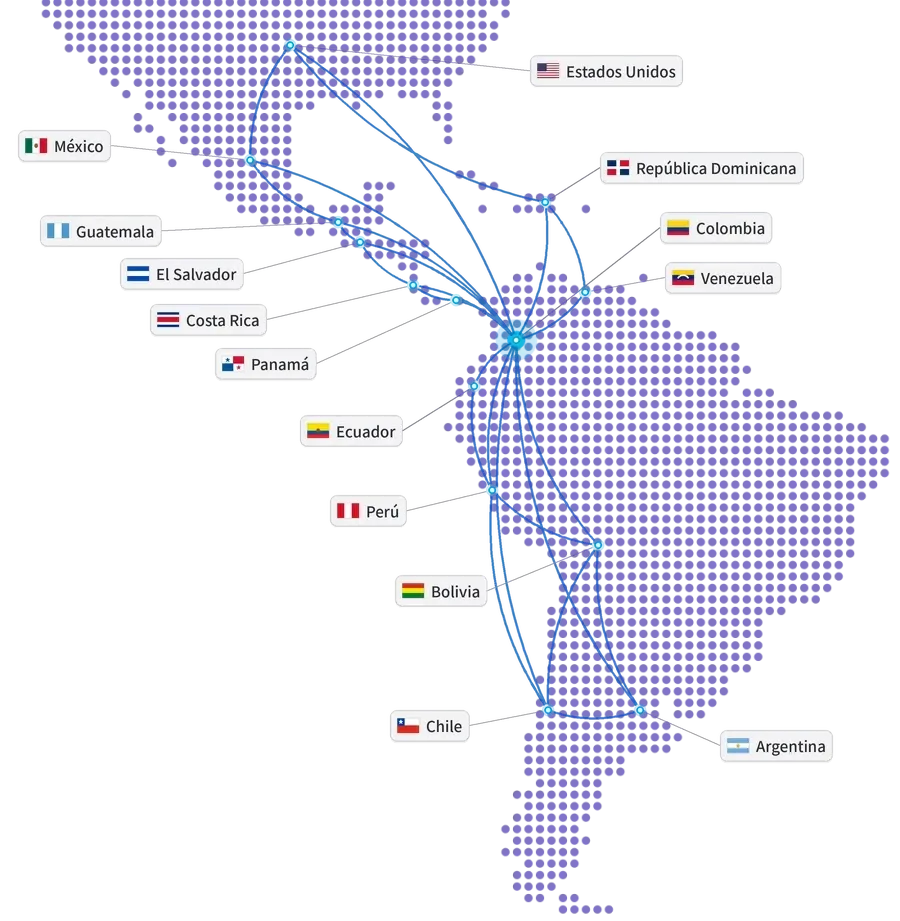
Global experience at your service
- Years of experience
- 15+
- Companies in Latin America
- 850+
- Countries
- 10+
- Integrations
- 100+
- ERP and ERP+ modules
- 40
- AI agents
- 20+
Companies that trust GIITIC






Questions about Document Verification and Control
What documents can the artificial intelligence agent manage?
How does it verify that a document is authentic?
Can the agent block a hiring or suspend a third party?
How does it track document validity?
How is it different from the Document Management and Compliance and Quality modules?
Do I need GIITIC or can I use my current systems?
Who controls what the agent does?
How long does implementation take, and how much does it cost?
 Next step
Ready to see your agent work in your process?
Let's talk about your operation. A consultant will review your process, your systems and your knowledge, and show you how the agent would work with your rules.
- Demo of the agent with cases from your process.
- Review of your systems and the available knowledge.
- Estimate of the scope and the next step.
Let's talk about your process
Fill in your details and a consultant will get in touch with you.
Registration successful
We'll be in touch with you shortly.