
Smart Quoting
See how the quoting process is evolving in organizations with AI agents.
- Prebuilt agent Ready to use, we do not start from scratch.We start from an agent prepared for this process and configure it with your rules, your systems and your way of working.
- Best practices Built in from day one.The agent's instructions incorporate the process practices we have applied when automating it in different organizations.
- Configured by experts Functional and technology consultants.Specialized consultants support the configuration, integration, testing and go-live of the agent in your operation.
- Agent platform Workforce AI.The agent runs on Workforce AI, GIITIC's own platform that centralizes security, permissions, audit, usage and administration of all your agents.
- Process experience Processes + technology + enterprise software.Behind every agent are years of experience implementing enterprise software and automating processes in companies across Latin America.
- GIITIC software ecosystem The tools the agent needs.We integrate with your current systems and, if you are missing one, the GIITIC ecosystem provides the modules the agent needs to query and act.

How it is done today, and why it is no longer enough
86% of B2B purchases stall during the process, according to Forrester (2024), and an average of 13 people take part in each decision. A quote that takes days, changes several times or arrives with errors gives the buyer more reasons to stop.
- Scattered requests
- Catalog and prices by hand
- Manual calculations
- Slow approvals
- Inconsistent proposals
- No history
Smart Quoting agent

I'm an artificial intelligence agent trained by experts, ready to use and built with best practices. I am here to prepare every quote you are asked for —with the right products, your price lists, discounts and business rules, and the customer’s history— and have the proposal ready to send in minutes. Anything that needs approval or falls outside your policies, I escalate to you with my recommendation.
Prebuilt, but adaptable to each organization.
How I work
- I detectEvery requestI receive quote requests from email, the CRM, the portal or the salesperson as soon as they arrive.
- I understandWhat the customer needsI interpret products, quantities, deadlines and terms, even when they arrive as free text, PDF or spreadsheet.
- I configureProducts and alternativesI select valid, available items and suggest alternatives or add-ons based on your rules.
- I calculatePrices and termsI apply your price lists, discounts, taxes, freight and margins according to the customer and the deal.
- I reviewCustomer historyI check previous purchases, quotes and terms to stay consistent with what was negotiated.
- I writeReady-to-send proposalI generate the quote or proposal with your template, your approved texts and the validity period you set.
- I escalateApprovals and exceptionsI pass you discounts outside policy, low margins or special cases with my recommendation.
Results you can achieve
- expect to use generative or agentic AI in pricing
- 65–85%Organizations that plan to adopt it within 1 to 3 years, compared with 10–30% today (survey of 419 B2B pricing executives, Nov. 2025).Source: McKinsey, “B2B pricing: Navigating the next phase of the AI revolution,” Apr 7, 2026
- of extra margin with pricing and discount agents
- +50 bpsMore than 50 basis points at a 15-billion-dollar B2B distributor that added a pricing advisor and a discount manager powered by agents.Source: McKinsey, “B2B pricing: Navigating the next phase of the AI revolution,” Apr 7, 2026
- in quoting time
- −75%According to the vendor: an internal Salesforce result with its quoting agent, together with 87% fewer clicks for its salespeople.Source: Salesforce, Agentforce for Revenue, Jul 16, 2025
- more likely to meet quota with AI
- 3.7×B2B salespeople who work effectively with AI tools compared with those who do not (survey of 1,026 salespeople, 2024).Source: Gartner, Sep 16, 2024
Reference values based on benchmarks and comparable scenarios. Results depend on the characteristics of each operation and are not guaranteed results.
Greater speed, higher quality, lower costs

Greater speed
Automate tasks and connect your information so your team responds sooner and your processes move forward without waiting.
- Prepares the quote in minutes, without waiting for the salesperson to be free
- Also answers requests that arrive outside business hours
- Brings exceptions to the approver with the information ready to decide
- Adjusts and resends new versions without starting from scratch

Higher quality
Standardize the work and control every step so your information is reliable and your results are consistent.
- Applies the same price lists, discounts and rules to every quote
- Uses only valid, current and available products
- Stays consistent with what the customer has already bought and negotiated
- Keeps a trail of every version, approval and term offered

Lower costs
Reduce rework, errors and manual work so your operation delivers more with the same resources.
- Reduces the hours salespeople spend looking up prices and building documents
- Avoids out-of-policy discounts and errors that erode margin
- Handles request peaks without growing the team at the same pace
- Frees salespeople to negotiate and close deals
Artificial intelligence in quote preparation
Before
- 3:00 p.m.3:00 p.m. · MilestoneA quote request for 12 products arrives by email
- 3:00 p.m.3:00 p.m. · Lost timeThe salesperson is out visiting customers2 h
- 5:00 p.m.5:00 p.m. · PersonReads the request and clarifies items and quantities with the customer15 min
- 5:15 p.m.5:15 p.m. · Lost timeEnd of the workday: the quote is left for the next day15 h 45 min
- 9:00 a.m. · day 29:00 a.m. · day 2 · PersonLooks up products, prices and stock in lists and systems30 min
- 9:30 a.m.9:30 a.m. · PersonCalculates discounts, taxes and freight in a spreadsheet20 min
- 9:50 a.m.9:50 a.m. · PersonAsks the sales manager to approve the special discount5 min
- 9:55 a.m.9:55 a.m. · Lost timeThe sales manager is in a committee meeting; approval arrives in the afternoon5 h
- 2:55 p.m.2:55 p.m. · PersonPuts the proposal together in the template and reviews it25 min
- 3:20 p.m.3:20 p.m. · PersonSends the quote to the customer and records it in the CRM10 min
- 3:30 p.m. · day 23:30 p.m. · day 2 · MilestoneQuote sent to the customer
Now
- 3:00 p.m.3:00 p.m. · MilestoneA quote request for 12 products arrives by email
- 3:00 p.m.3:00 p.m. · AgentReads the request, identifies the customer and checks their history in the CRM< 1 min
- 3:01 p.m.3:01 p.m. · AgentSelects the products, verifies stock and calculates prices, taxes and freight< 1 min
- 3:02 p.m.3:02 p.m. · AgentBecause the requested discount exceeds your policy, escalates it with the margin and its recommendation< 1 min
- 3:03 p.m.3:03 p.m. · Lost timeThe sales manager finishes their meeting45 min
- 3:48 p.m.3:48 p.m. · PersonReviews the agent’s recommendation and approves the discount5 min
- 3:53 p.m.3:53 p.m. · AgentGenerates the proposal, sends it to the customer and records it in the CRM< 1 min
- 3:54 p.m.3:54 p.m. · MilestoneQuote sent the same day
Tangible results in your operation
| Indicator | Before | Now | Factor |
|---|---|---|---|
| End-to-end cycle time | ≈ 24 h 30 min | ≈ 54 min | ×27 |
| Human work time | 1 h 45 min | 5 min | ×21 |
| Waiting time | 22 h 45 min | 45 min | ×30 |
| Human intervention | 100% | ≈ 40% | ÷2.5 |
| Team capacity | 1× | ≈ 2.5× | ×2.5 |
Illustrative reference scenario. Times depend on each operation and are validated with your data.
Your team moves from operating to deciding
The capacity the agent frees up goes to analysis, decisions, relationships, exceptions, improvement and innovation.
No more low-value manual tasks
- Looking up products, prices and stock across several files
- Calculating discounts, taxes and freight in spreadsheets
- Copying and pasting texts and terms into every proposal
- Chasing approvals by email and messages
- Manually recording every quote in the CRM
The team adds value to the operation
- Negotiate with the customer with a ready, consistent proposal
- Spend their time on large or complex deals
- Analyze why quotes are won or lost
- Adjust prices, discounts and bundles with up-to-date information
- Follow up on sent proposals to close them
Your team's professional growth
- Pricing and commercial policy ownerDefines the price lists, discounts, margins and approval levels the agent applies.
- Agent supervisorReviews the quality of the quotes, adjusts rules and governs the agent’s knowledge.
- Quote conversion analystMeasures which proposals are won, why and under what terms, and suggests improvements.
Agents are only as good as the knowledge and context they handle
It is one of the great challenges of enterprise artificial intelligence (AI): an agent without clear rules, reliable data and business context makes mistakes or stops. That is why knowledge is prepared, governed and improved as part of the project.
- Product and service catalog, with item numbers, compatibilities and alternatives
- Price lists by customer, channel, currency and validity
- Discount policies, minimum margins and approval levels
- Tax and freight rules, and delivery and payment terms

The knowledge this agent handles
- Proposal templates and approved sales texts
- History of each customer: purchases, quotes and negotiated terms
- Cases that require human review before sending
60%
of AI projects without AI-ready data will be abandoned through 2026, according to Gartner. Gartner, “Lack of AI-Ready Data Puts AI Projects at Risk,” February 2025
Workforce AI helps you prepare, govern and improve it
- Instructions prebuilt by experts
- Process best practices
- Tools to create and capture knowledge
- Knowledge management
- Integration with your current sources
- Enrichment of existing knowledge
- Ongoing updates
- Knowledge governance
- Continuous learning and improvement
We integrate with your environment
We connect the agent with virtually any application, API, service or data source in your company, whether GIITIC or third-party systems.
Integrations this agent requires
- CRM and ERPYour CRM or ERP (Salesforce, SAP or other) or GIITIC: customers, products, prices, stock and sales history.
- Email and channelsRequest mailboxes, portals and the channels your company uses to receive orders and send quotes.
- Templates and documentsYour proposal templates and the PDF or spreadsheet documents customers send with their orders.

Your agent, connected to your operation
Base systems for agents
If you do not have the base system, we provide reduced versions of GIITIC modules with the capabilities the agent needs to work.
- Sales for agentsA streamlined version of GIITIC Sales: products, price lists, discounts, quotes and orders.
- CRM for agentsA streamlined version of GIITIC CRM: accounts, contacts, opportunities and linked quotes.
- Applications and ERP
- APIs and web services
- Databases and files
- MCP (Model Context Protocol), when applicable
An agent needs software tools to query information and carry out actions. Without them, it stays a conversation. That is why we cover both paths: connecting to what you already have or giving you what you are missing.
See GIITIC integrations95%
of organizations struggle to integrate AI into their existing processes. MuleSoft (Salesforce), Connectivity Benchmark Report 2025, study sponsored with Vanson Bourne and Deloitte Digital
Today it is one agent, tomorrow dozens
Every area will add agents working at the same time. Workforce AI is the control center of your digital workforce, not an isolated script.
Explore Workforce AI- Agent creation and management
- Security, identities and permissions
- Policies and human oversight
- Traceability and audit
- Observability, quality and results
- Models, tokens, usage and costs
- Continuous updates to new AI models and features
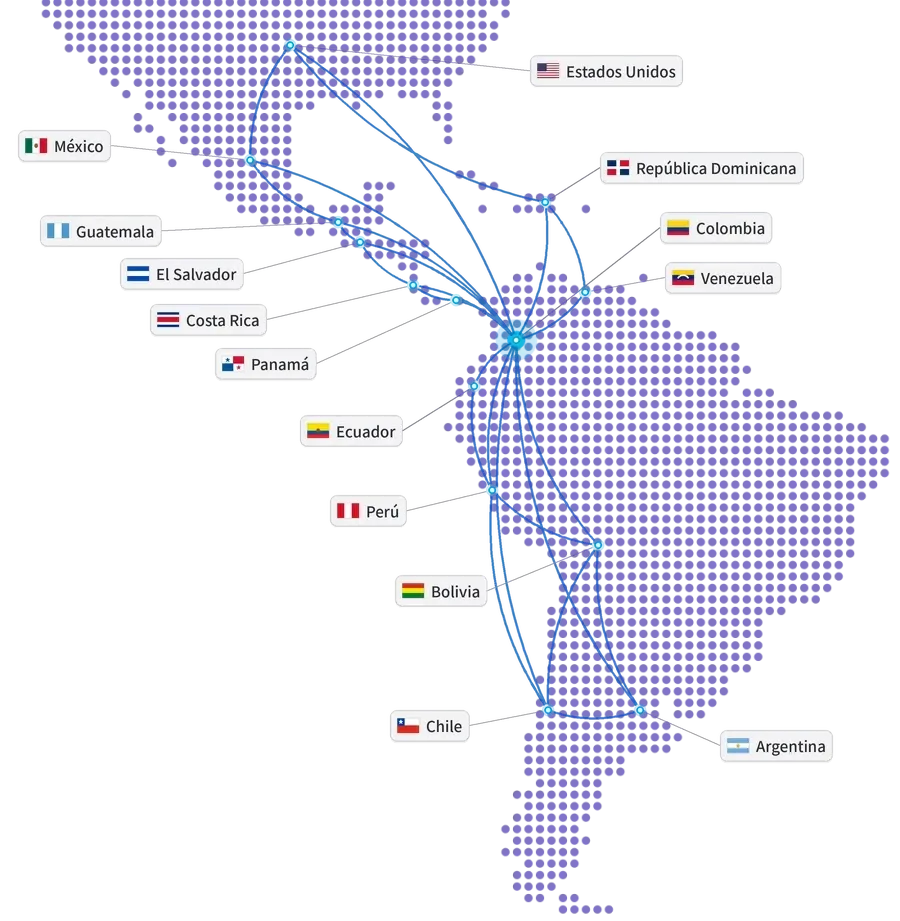
Global experience at your service
- Years of experience
- 15+
- Companies in Latin America
- 850+
- Countries
- 10+
- Integrations
- 100+
- ERP and ERP+ modules
- 40
- AI agents
- 20+
Companies that trust GIITIC






Questions about Smart Quoting
What quotes can the artificial intelligence agent prepare?
Can the agent give discounts on its own?
Does it send quotes directly to the customer?
Do I need GIITIC ERP or GIITIC CRM?
How does it adapt to my prices and commercial policies?
Who controls what the agent does?
How long does implementation take and how much does it cost?
What happens to my sales team?
 Next step
Ready to see your agent work in your process?
Let's talk about your operation. A consultant will review your process, your systems and your knowledge, and show you how the agent would work with your rules.
- Demo of the agent with cases from your process.
- Review of your systems and the available knowledge.
- Estimate of the scope and the next step.
Let's talk about your process
Fill in your details and a consultant will get in touch with you.
Registration successful
We'll be in touch with you shortly.