
Smart Recruiting
See how recruiting is evolving in organizations with AI agents.
- Prebuilt agent Ready to use, we do not start from scratch.We start from an agent prepared for this process and configure it with your rules, your systems and your way of working.
- Best practices Built in from day one.The agent's instructions incorporate the process practices we have applied when automating it in different organizations.
- Configured by experts Functional and technology consultants.Specialized consultants support the configuration, integration, testing and go-live of the agent in your operation.
- Agent platform Workforce AI.The agent runs on Workforce AI, GIITIC's own platform that centralizes security, permissions, audit, usage and administration of all your agents.
- Process experience Processes + technology + enterprise software.Behind every agent are years of experience implementing enterprise software and automating processes in companies across Latin America.
- GIITIC software ecosystem The tools the agent needs.We integrate with your current systems and, if you are missing one, the GIITIC ecosystem provides the modules the agent needs to query and act.

How it is done today, and why it is no longer enough
Hiring takes longer and longer: according to the Global Talent Climate report from The Josh Bersin Company and AMS, the average time to hire reached 44 days in 2023, an all-time high.
- Copied profiles
- Unclear criteria
- Improvised assessments
- Slow approvals
- Manual posting
- Coordination by email
Smart Recruiting agent

I'm an artificial intelligence agent trained by experts, ready to use and built with best practices. I am here to prepare each opening from the moment you request it: I build the profile and criteria with your role and your experience, create the assessments and the interview guide, post the opening and coordinate schedules, notices and stages of the process. You approve the profile and decide who to hire.
Prebuilt, but adaptable to each organization.
How I work
- I detectOpening requestI receive the hiring manager’s request with the role, the department, the date and the reason for the opening.
- I understandRole and contextI read the role profile, its competencies and previous hires for that role.
- I analyzeProfile and criteriaI propose requirements, competencies and measurable evaluation criteria for the opening.
- I decideAssessmentsI create the technical test and the structured interview guide aligned with the criteria.
- I executePostingI write the job posting and publish it on your careers portal and the channels you define.
- I verifyProcess coordinationI schedule interviews, notify candidates and hiring managers, send reminders and alert you to delays.
Results you can achieve
- validity of the structured interview
- 0.42The selection procedure that best predicts job performance, ahead of cognitive ability (0.31).Source: Sackett et al., Journal of Applied Psychology, 2022
- use AI to generate job descriptions
- 65%Of organizations that use AI in recruiting; 42% use it to personalize job postings.Source: SHRM, survey of 2,366 HR professionals, 2024
- report less time to fill openings
- 69%HR professionals who use AI or automation and say that time to fill openings improved.Source: SHRM, survey of 1,688 members, 2022
- of the recruiter’s week freed up
- 20%According to the vendor, teams that use generative AI in recruiting save an average of one workday per week.Source: LinkedIn, The Future of Recruiting 2025 (vendor)
Reference values based on benchmarks and comparable scenarios. Results depend on the characteristics of each operation and are not guaranteed results.
Greater speed, higher quality, lower costs

Greater speed
Automate tasks and connect your information so your team responds sooner and your processes move forward without waiting.
- Prepares the profile, criteria, assessments and posting in minutes from the request
- Posts the opening on all the defined channels in a single step
- Schedules interviews and sends notices and reminders without email back-and-forth
- Alerts you to overdue stages so the process doesn’t stall

Higher quality
Standardize the work and control every step so your information is reliable and your results are consistent.
- Defines measurable criteria before receiving candidates
- Creates structured interview guides and assessments aligned with the role
- Applies the same process and the same criteria to every opening
- Uses clear, inclusive language in job postings

Lower costs
Reduce rework, errors and manual work so your operation delivers more with the same resources.
- Reduces the recruiter’s hours on repetitive tasks for each opening
- Avoids repeating processes because of poorly defined profiles
- Shortens the time the role stays vacant
- Frees the team to focus on relationships with candidates and hiring managers
Artificial intelligence in opening preparation and coordination
Before
- 9:00 a.m.9:00 a.m. · MilestoneThe hiring manager requests to fill an opening by email
- 9:00 a.m.9:00 a.m. · Lost timeThe request waits its turn in the recruiter’s queue24 h
- 9:00 a.m. · day 29:00 a.m. · day 2 · PersonGathers the previous role description and adjusts it30 min
- 9:30 a.m.9:30 a.m. · Lost timeThe meeting with the hiring manager is pushed to the next day24 h
- 9:30 a.m. · day 39:30 a.m. · day 3 · PersonDefines the profile and criteria with the hiring manager45 min
- 10:15 a.m.10:15 a.m. · PersonPrepares the technical test and the interview guide1 h
- 11:15 a.m.11:15 a.m. · Lost timeWaits for approval from the hiring manager and HR28 h
- 3:15 p.m. · day 43:15 p.m. · day 4 · PersonWrites the posting and publishes it on the portal and on two job boards45 min
- 4:00 p.m. · day 44:00 p.m. · day 4 · MilestoneOpening posted
Now
- 9:00 a.m.9:00 a.m. · MilestoneThe hiring manager requests to fill an opening
- 9:00 a.m.9:00 a.m. · AgentReads the request and the role profile in the company structure< 1 min
- 9:01 a.m.9:01 a.m. · AgentProposes the profile, criteria, technical test and interview guide and sends them to the hiring manager5 min
- 9:06 a.m.9:06 a.m. · Lost timeThe hiring manager finishes their current task1 h
- 10:06 a.m.10:06 a.m. · PersonAdjusts one criterion and approves the agent’s proposal10 min
- 10:16 a.m.10:16 a.m. · AgentWrites the posting, publishes it on the defined channels and opens the interview schedule< 1 min
- 10:17 a.m.10:17 a.m. · MilestoneOpening posted the same morning
Tangible results in your operation
| Indicator | Before | Now | Factor |
|---|---|---|---|
| End-to-end cycle time | ≈ 79 h | ≈ 1.3 h | ×62 |
| Human work time | 3 h | 10 min | ×18 |
| Waiting time | 76 h | 1 h | ×76 |
| Human intervention | 100% | ≈ 50% | ÷2 |
| Team capacity | 1× | ≈ 2× | ×2 |
Illustrative reference scenario. Times depend on each operation and are validated with your data.
Your team moves from operating to deciding
The capacity the agent frees up goes to analysis, decisions, relationships, exceptions, improvement and innovation.
No more low-value manual tasks
- Copying and adjusting previous job descriptions
- Building tests and interview guides from scratch
- Posting the same job ad on every job board
- Coordinating interview schedules by email
- Chasing hiring managers and candidates with reminders
The team adds value to the operation
- Advising hiring managers on the profile and hiring decisions
- Building relationships with candidates and caring for their experience
- Attracting talent for the hardest roles to fill
- Improving criteria and tests with the results of each hire
- Analyzing times and sources to improve the process
Your team's professional growth
- Recruiting advisorSupports the hiring manager with the profile, the interviews and the final decision.
- Agent supervisorReviews profiles, criteria and postings, adjusts rules and governs the agent’s knowledge.
- Talent acquisition specialistBuilds the employer brand and sources candidates for critical roles.
Agents are only as good as the knowledge and context they handle
It is one of the great challenges of enterprise artificial intelligence (AI): an agent without clear rules, reliable data and business context makes mistakes or stops. That is why knowledge is prepared, governed and improved as part of the project.
- Role profiles, competencies and levels in the company
- Evaluation criteria and scales by type of role
- Bank of technical tests and structured interview guides

The knowledge this agent handles
- Recruiting policies, approvals and legal requirements for postings
- Posting channels and their performance by type of role
- Availability of hiring managers and interviewers
60%
of AI projects without AI-ready data will be abandoned through 2026, according to Gartner. Gartner, “Lack of AI-Ready Data Puts AI Projects at Risk,” February 2025
Workforce AI helps you prepare, govern and improve it
- Instructions prebuilt by experts
- Process best practices
- Tools to create and capture knowledge
- Knowledge management
- Integration with your current sources
- Enrichment of existing knowledge
- Ongoing updates
- Knowledge governance
- Continuous learning and improvement
We integrate with your environment
We connect the agent with virtually any application, API, service or data source in your company, whether GIITIC or third-party systems.
Integrations this agent requires
- Job portals and networksYour careers portal, job boards and professional networks where openings are posted.
- Recruiting or HR systemYour applicant tracking system (ATS) or HR system, or GIITIC: openings, roles, candidates and stages.
- Calendar and emailSchedules of hiring managers and interviewers, notices and reminders for the process.

Your agent, connected to your operation
Base systems for agents
If you do not have the base system, we provide reduced versions of GIITIC modules with the capabilities the agent needs to work.
- Recruiting and onboarding for agentsA reduced version of GIITIC Recruiting, Hiring and Onboarding: openings, posting, stages and scheduling.
- Talent and organization for agentsA reduced version of GIITIC Talent Management: roles, profiles and competencies that the agent uses.
- Applications and ERP
- APIs and web services
- Databases and files
- MCP (Model Context Protocol), when applicable
An agent needs software tools to query information and carry out actions. Without them, it stays a conversation. That is why we cover both paths: connecting to what you already have or giving you what you are missing.
See GIITIC integrations95%
of organizations struggle to integrate AI into their existing processes. MuleSoft (Salesforce), Connectivity Benchmark Report 2025, study sponsored with Vanson Bourne and Deloitte Digital
Today it is one agent, tomorrow dozens
Every area will add agents working at the same time. Workforce AI is the control center of your digital workforce, not an isolated script.
Explore Workforce AI- Agent creation and management
- Security, identities and permissions
- Policies and human oversight
- Traceability and audit
- Observability, quality and results
- Models, tokens, usage and costs
- Continuous updates to new AI models and features
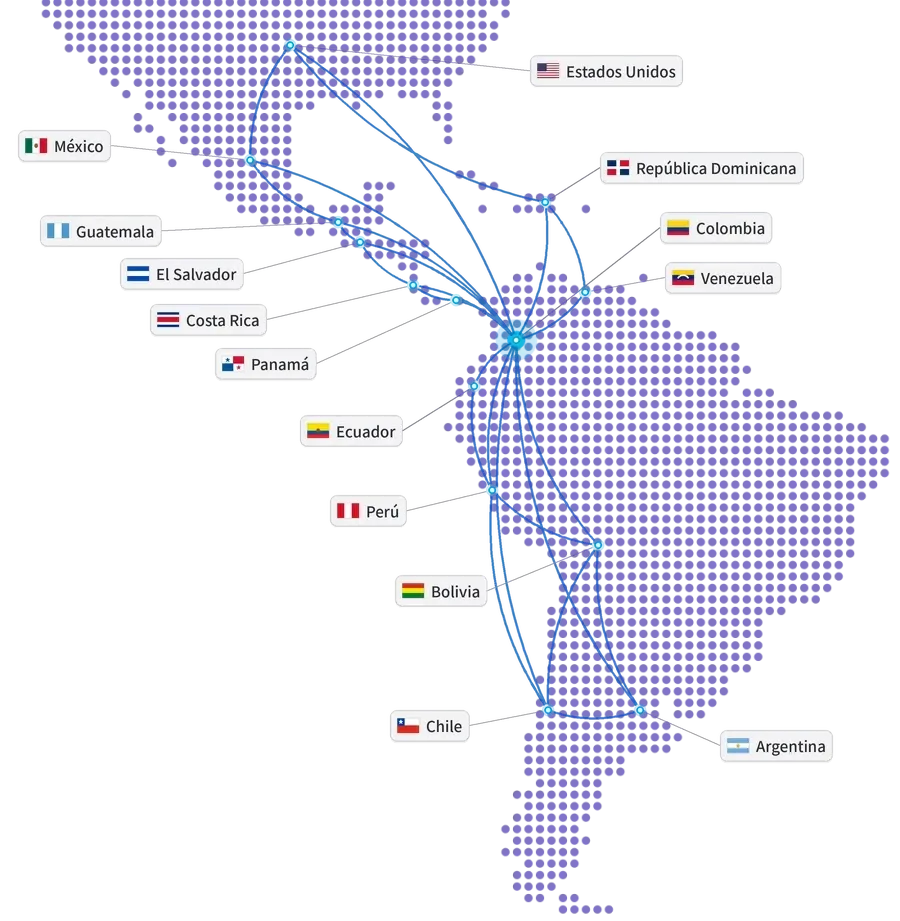
Global experience at your service
- Years of experience
- 15+
- Companies in Latin America
- 850+
- Countries
- 10+
- Integrations
- 100+
- ERP and ERP+ modules
- 40
- AI agents
- 20+
Companies that trust GIITIC






Questions about Smart Recruiting
What does the artificial intelligence agent do in a recruiting process?
Who decides the profile and who gets hired?
How does it avoid bias in postings and criteria?
Do I need GIITIC, or can I use my current systems?
What knowledge does it need, and who maintains it?
Who controls what the agent does?
How long does implementation take, and how much does it cost?
What happens to my recruiting team?
 Next step
Ready to see your agent work in your process?
Let's talk about your operation. A consultant will review your process, your systems and your knowledge, and show you how the agent would work with your rules.
- Demo of the agent with cases from your process.
- Review of your systems and the available knowledge.
- Estimate of the scope and the next step.
Let's talk about your process
Fill in your details and a consultant will get in touch with you.
Registration successful
We'll be in touch with you shortly.