
Smart Work Organization
See how work organization is evolving in organizations with AI agents.
- Prebuilt agent Ready to use, we do not start from scratch.We start from an agent prepared for this process and configure it with your rules, your systems and your way of working.
- Best practices Built in from day one.The agent's instructions incorporate the process practices we have applied when automating it in different organizations.
- Configured by experts Functional and technology consultants.Specialized consultants support the configuration, integration, testing and go-live of the agent in your operation.
- Agent platform Workforce AI.The agent runs on Workforce AI, GIITIC's own platform that centralizes security, permissions, audit, usage and administration of all your agents.
- Process experience Processes + technology + enterprise software.Behind every agent are years of experience implementing enterprise software and automating processes in companies across Latin America.
- GIITIC software ecosystem The tools the agent needs.We integrate with your current systems and, if you are missing one, the GIITIC ecosystem provides the modules the agent needs to query and act.

How it is done today, and why it is no longer enough
Clarity at work is declining: according to Gallup, in 2024 only 46% of employees in the United States knew clearly what was expected of them, 10 points lower than in 2020.
- Scattered to-dos
- Everything is urgent
- Meetings to hand out work
- Unbalanced workloads
- Missed deadlines
- No view of progress
Smart Work Organization agent

I'm an artificial intelligence agent trained by experts, ready to use and built with best practices. I am here to turn what reaches your team —requests, emails, meetings and goals— into clear tasks, prioritize them by impact, urgency and goals, and assign them to whoever has the capacity and the skills. If priorities need to change, I propose it to you first.
Prebuilt, but adaptable to each organization.
How I work
- I detectNew workI identify requests and commitments in your company’s emails, chats, meetings and systems.
- I understandClear tasksI turn each request or goal into tasks with an expected outcome, a due date and context.
- I analyzePriorityI rank tasks by goals, impact, urgency, dependencies and committed dates.
- I decideAssignmentI propose who should do each one based on their capacity, skills and what they already have in progress.
- I executeTeam planI create and assign the tasks in your tool and notify each owner.
- I verifyFollow-upI alert you to overloads, conflicts and at-risk dates, and propose adjustments before they happen.
Results you can achieve
- of time spent on automatable activities
- 60–70%Generative AI and other technologies could automate activities that today take up that share of employees’ time.Source: McKinsey Global Institute, 2023
- of the day goes to “work about work”
- 58%According to the vendor, coordinating, searching for information and chasing progress takes up most of knowledge workers’ day.Source: Asana, Anatomy of Work Global Index 2023 (vendor)
- have seen projects delayed by volume
- 88%According to the vendor, urgent projects and large initiatives are delayed or lost because of the number of pending tasks.Source: Asana, Anatomy of Work Global Index 2023 (vendor)
Reference values based on benchmarks and comparable scenarios. Results depend on the characteristics of each operation and are not guaranteed results.
Greater speed, higher quality, lower costs

Greater speed
Automate tasks and connect your information so your team responds sooner and your processes move forward without waiting.
- Turns requests into assigned tasks in minutes, without waiting for the planning meeting
- Reorganizes priorities when something urgent comes in
- Tells each owner what to do and by when
- Detects at-risk dates in time to react

Higher quality
Standardize the work and control every step so your information is reliable and your results are consistent.
- Prioritizes with the same criteria of goals, impact and urgency
- Assigns based on skills and actual workload, not on who happens to look available
- Keeps the team board up to date and complete
- Leaves an audit trail of why each task was prioritized and assigned

Lower costs
Reduce rework, errors and manual work so your operation delivers more with the same resources.
- Reduces the time spent on coordination and on meetings to hand out work
- Balances workloads to avoid overtime and forgotten tasks
- Avoids duplicated work by keeping all tasks in a single plan
- Frees managers to decide and support, not to chase progress
Artificial intelligence in team work organization
Before
- 8:00 a.m.8:00 a.m. · MilestoneAn urgent customer request and three new to-dos arrive
- 8:00 a.m.8:00 a.m. · Lost timeThe tasks wait for the afternoon planning meeting6 h
- 2:00 p.m.2:00 p.m. · PersonThe manager reviews to-dos, emails and the board30 min
- 2:30 p.m.2:30 p.m. · PersonPrioritizes the tasks in the meeting with the team45 min
- 3:15 p.m.3:15 p.m. · Lost timeWaits to confirm the availability of two people busy with other tasks17 h
- 8:15 a.m. · day 28:15 a.m. · day 2 · PersonReassigns, updates the board and notifies each owner30 min
- 8:45 a.m. · day 28:45 a.m. · day 2 · MilestoneTasks assigned with priority and due date
Now
- 8:00 a.m.8:00 a.m. · MilestoneAn urgent customer request and three new to-dos arrive
- 8:00 a.m.8:00 a.m. · AgentDetects the requests in email, the CRM and the board and creates the tasks< 1 min
- 8:01 a.m.8:01 a.m. · AgentPrioritizes by goals, impact and urgency and checks the team’s capacity and skills< 1 min
- 8:02 a.m.8:02 a.m. · AgentSince the urgency requires moving a task from another project, proposes the change to the manager< 1 min
- 8:03 a.m.8:03 a.m. · Lost timeThe manager finishes their current meeting45 min
- 8:48 a.m.8:48 a.m. · PersonApproves the priority change proposed by the agent5 min
- 8:53 a.m.8:53 a.m. · AgentAssigns the tasks, updates the board and notifies each owner< 1 min
- 8:54 a.m.8:54 a.m. · MilestoneTasks assigned with priority and due date the same morning
Tangible results in your operation
| Indicator | Before | Now | Factor |
|---|---|---|---|
| End-to-end cycle time | ≈ 24.8 h | ≈ 54 min | ×27 |
| Human work time | 1 h 45 min | 5 min | ×21 |
| Waiting time | 23 h | 45 min | ×31 |
| Human intervention | 100% | ≈ 40% | ÷2.5 |
| Team capacity | 1× | ≈ 2.5× | ×2.5 |
Illustrative reference scenario. Times depend on each operation and are validated with your data.
Your team moves from operating to deciding
The capacity the agent frees up goes to analysis, decisions, relationships, exceptions, improvement and innovation.
No more low-value manual tasks
- Going through emails and chats to find to-dos
- Handing out tasks in planning meetings
- Updating boards by hand
- Asking one by one how each task is going
- Reorganizing everything when something urgent comes in
The team adds value to the operation
- Setting clear goals and priority criteria
- Deciding priority changes using the agent’s proposal
- Supporting the team on complex tasks and blockers
- Balancing workloads and developing the team’s skills
- Improving how work gets done using progress and workload data
Your team's professional growth
- Priorities leadSets goals and criteria and decides the changes the agent proposes.
- Agent supervisorReviews the quality of assignments, adjusts rules and governs the agent’s knowledge.
- Team capacity analystUses workload and progress data to plan resources and skills.
Agents are only as good as the knowledge and context they handle
It is one of the great challenges of enterprise artificial intelligence (AI): an agent without clear rules, reliable data and business context makes mistakes or stops. That is why knowledge is prepared, governed and improved as part of the project.
- Company and department goals, targets and initiatives
- Priority criteria: impact, urgency, customers and commitments
- Skills, roles and capacity of each team member

The knowledge this agent handles
- Projects, dependencies and committed dates
- Assignment, approval and escalation rules
- Team calendars, absences and shifts
60%
of AI projects without AI-ready data will be abandoned through 2026, according to Gartner. Gartner, “Lack of AI-Ready Data Puts AI Projects at Risk,” February 2025
Workforce AI helps you prepare, govern and improve it
- Instructions prebuilt by experts
- Process best practices
- Tools to create and capture knowledge
- Knowledge management
- Integration with your current sources
- Enrichment of existing knowledge
- Ongoing updates
- Knowledge governance
- Continuous learning and improvement
We integrate with your environment
We connect the agent with virtually any application, API, service or data source in your company, whether GIITIC or third-party systems.
Integrations this agent requires
- Email, chat and calendarEmails, chats, meetings and calendars where requests arrive and availability shows up.
- Tasks and projectsYour task or project tool (Planner, Jira or another) or GIITIC: boards, tasks and owners.
- Work-source systemsCRM, help desk, ERP or other systems where requests and commitments originate.

Your agent, connected to your operation
Base systems for agents
If you do not have the base system, we provide reduced versions of GIITIC modules with the capabilities the agent needs to work.
- Project Management for agentsA reduced version of GIITIC Project Management: tasks, owners, dates, dependencies and team workload.
- Executive management for agentsA reduced version of GIITIC Integrated Executive Management System: goals and initiatives that guide priorities.
- Applications and ERP
- APIs and web services
- Databases and files
- MCP (Model Context Protocol), when applicable
An agent needs software tools to query information and carry out actions. Without them, it stays a conversation. That is why we cover both paths: connecting to what you already have or giving you what you are missing.
See GIITIC integrations95%
of organizations struggle to integrate AI into their existing processes. MuleSoft (Salesforce), Connectivity Benchmark Report 2025, study sponsored with Vanson Bourne and Deloitte Digital
Today it is one agent, tomorrow dozens
Every area will add agents working at the same time. Workforce AI is the control center of your digital workforce, not an isolated script.
Explore Workforce AI- Agent creation and management
- Security, identities and permissions
- Policies and human oversight
- Traceability and audit
- Observability, quality and results
- Models, tokens, usage and costs
- Continuous updates to new AI models and features
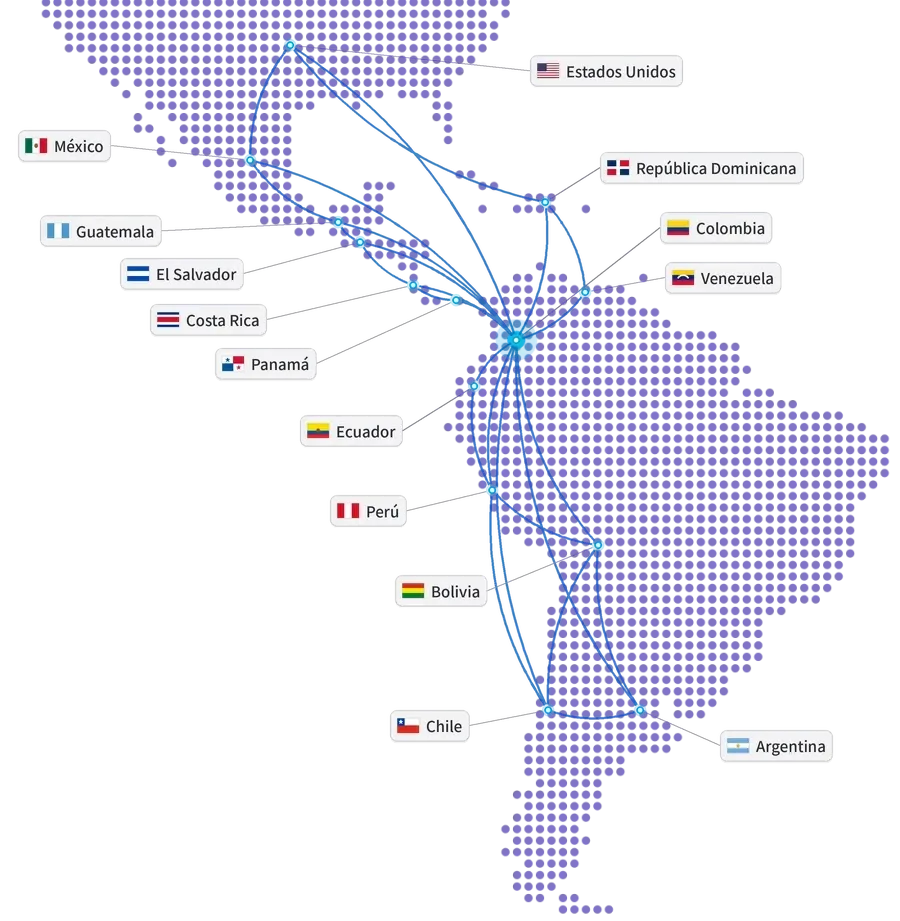
Global experience at your service
- Years of experience
- 15+
- Companies in Latin America
- 850+
- Countries
- 10+
- Integrations
- 100+
- ERP and ERP+ modules
- 40
- AI agents
- 20+
Companies that trust GIITIC






Questions about Smart Work Organization
What work does the artificial intelligence agent organize?
Does the agent decide priorities for me?
How does it know who has the capacity for each task?
Do I need GIITIC, or can I use my current tools?
How does it adapt to the way my team works?
Who controls what the agent does?
How long does implementation take, and how much does it cost?
What happens to managers and the team?
 Next step
Ready to see your agent work in your process?
Let's talk about your operation. A consultant will review your process, your systems and your knowledge, and show you how the agent would work with your rules.
- Demo of the agent with cases from your process.
- Review of your systems and the available knowledge.
- Estimate of the scope and the next step.
Let's talk about your process
Fill in your details and a consultant will get in touch with you.
Registration successful
We'll be in touch with you shortly.