Por confirmar
Integrated cloud security
Native connectivity and deployment on Microsoft Azure AD, AWS and Google Cloud Platform. AES-256 encryption at rest for databases and TLS 1.3 on all data-in-transit channels.
Zero-Trust architecture

No menu results
Every GIITIC module, workflow and data point runs on a common platform: security at the core, integration with your systems, and mobile and business intelligence capabilities.
Multilayer protection, practices aligned with ISO 27001 guidelines and traceability of every interaction.
Native connectivity and deployment on Microsoft Azure AD, AWS and Google Cloud Platform. AES-256 encryption at rest for databases and TLS 1.3 on all data-in-transit channels.
Two-factor authentication (2FA / MFA) and SSO identity federation through SAML 2.0 and OAuth. Dynamic password policies and granular permissions by module, role, operating center and data field.
Comprehensive audit log: it records the creation, modification, reading or export of records with UTC date and time, user, IP address and cryptographic hash signature.
Designed for companies with multiple sites, subsidiaries and geographically distributed operations.
The same business rules run on desktop browsers, tablets and smartphones, with native iOS and Android apps.
Parallel management of functional and presentation currencies (USD, COP, EUR, MXN, BRL). Automated daily updates with official exchange rates and accounting consolidation under IFRS standards.
User profiles in Spanish, English and Portuguese. Localization of date formats, tax regulations and tax withholdings for each country of operation.
Guided transition from your previous tools and coexistence with the systems you already use.
Bulk upload wizard from spreadsheets (.xlsx, .csv), external databases or REST/SOAP web services, with pre-validation and advance notice of inconsistencies.
Automated migration tools to reduce the workload and risks of the transition, with assisted mapping and integrity validation to avoid duplicates or orphaned data.
Download views to Excel, PDF and XML. OData connectors to link with Microsoft Power BI, Tableau or corporate data lakes.
Eliminate bottlenecks with workflows, customizable no-code forms and fast authorizations.
Visual workflow designer to model stages, conditions and assignments. Track progress on Kanban boards with detection of delays and deviations.
Create and modify custom fields, conditional required-field rules and dependent lists without developers. Adapt data capture to each area.
Define authorization matrices by amount, cost center or department. Receive notifications and approve from email or your mobile phone.
Make decisions with consolidated data from your operation. [to be confirmed: BI availability by line; the company’s own BI does not imply inclusion in ERP]
Executive and operational visualization synchronized with accounting, purchasing, inventory or sales transactions.
Ask a Workforce AI agent about shrinkage, collection trends or operational projections. It requires a Workforce AI use case; it is not included in ERP.
Monitoring of critical thresholds with visual alerts for budget deviations, margin drops or stockouts.
Real-time location to supervise fleets, sales visits, field audits and logistics distribution. [to be confirmed]
Automatic recording of coordinates at every visit to customers, warehouses or service centers.
Calculation of distances and visit sequences to reduce travel time.
Alerts if technical or delivery staff leave the defined zone.
Tools for your technical, sales and logistics teams, even in areas without coverage. [to be confirmed: capabilities by line and product]
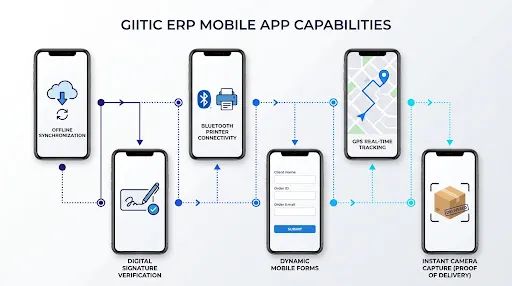
Capture orders, signatures and inspections without a cell signal; data syncs when the connection is restored.
Issue invoices, cash receipts and delivery proofs from portable thermal printers.
Monitor the routes of technical and sales staff, with a record of the time spent at each customer.
On-screen signature capture for service reports, delivery notes and delivery acceptances.
Photo evidence with date, time and geographic coordinates.
Check key indicators and authorize purchase orders from your smartphone.
GIITIC connects with ERP, payment gateways, e-documents, cloud, digital signature, telephony, messaging, maps, email and AI models, through different integration mechanisms.
Open architecture to exchange data and events.
Batch exchange and bulk upload.
SQL, ODBC and JDBC connection.
Libraries and connectors for in-house systems.
Talk to a GIITIC specialist. We review your current infrastructure, integration flows and security requirements.