
Smart Reports
See how report building is evolving in organizations with AI agents.
- Prebuilt agent Ready to use, we do not start from scratch.We start from an agent prepared for this process and configure it with your rules, your systems and your way of working.
- Best practices Built in from day one.The agent's instructions incorporate the process practices we have applied when automating it in different organizations.
- Configured by experts Functional and technology consultants.Specialized consultants support the configuration, integration, testing and go-live of the agent in your operation.
- Agent platform Workforce AI.The agent runs on Workforce AI, GIITIC's own platform that centralizes security, permissions, audit, usage and administration of all your agents.
- Process experience Processes + technology + enterprise software.Behind every agent are years of experience implementing enterprise software and automating processes in companies across Latin America.
- GIITIC software ecosystem The tools the agent needs.We integrate with your current systems and, if you are missing one, the GIITIC ecosystem provides the modules the agent needs to query and act.

How it is done today, and why it is no longer enough
Teams spend more time gathering data than analyzing it: in the FP&A Trends 2024 survey, only 35% of financial planning professionals’ time went to high-value tasks such as generating insights.
- Data in several systems
- Fragile spreadsheets
- Numbers that don’t match
- Charts with no explanation
- Reports that arrive late
- Questions that wait
Smart Reports agent

I'm an artificial intelligence agent trained by experts, ready to use and built with best practices. I am here to build your reports: I find and consolidate information from your systems, reconcile differences, analyze variances and trends, and write insights and conclusions with charts and the source of every figure. Anything I can’t explain with the data, I ask about or flag for you.
Prebuilt, but adaptable to each organization.
How I work
- I detectReport needI understand which report you need, for whom, for what period and which questions it must answer.
- I understandData from your systemsI find and consolidate information from your ERP, CRM, spreadsheets and documents.
- I analyzeVariances and trendsI reconcile differences and analyze changes by period, region, product or customer.
- I decideInsightsI identify what weighs most on the result and propose explanations based on the data.
- I executeReportI write the report with insights, conclusions and charts in the format you use.
- I verifySources and validationI cite the source of every figure, ask about what the data doesn’t explain and flag what you should validate.
Results you can achieve
- less time writing with AI
- −40%Experiment with 453 professionals on tasks typical of their jobs; quality also rose 18%.Source: Noy and Zhang, Science, 2023
- already use AI for automated insights
- 50%+More than half of 403 analytics or AI leaders say their organization uses AI for automated insights and natural-language queries.Source: Gartner, 2025
- of analytics content with AI by 2027
- 75%Projection: three out of four new pieces of analytics content will use generative AI to provide context and connect insights to actions.Source: Gartner, 2025
Reference values based on benchmarks and comparable scenarios. Results depend on the characteristics of each operation and are not guaranteed results.
Greater speed, higher quality, lower costs

Greater speed
Automate tasks and connect your information so your team responds sooner and your processes move forward without waiting.
- Consolidates information from several systems in minutes
- Delivers the report the same day the figures close
- Explains variances without waiting for each department to respond
- Prepares recurring reports automatically

Higher quality
Standardize the work and control every step so your information is reliable and your results are consistent.
- Reconciles differences between sources before writing
- Cites the source of every figure so it can be reviewed
- Explains why the results happened, not just what happened
- Uses the same structure and criteria in every period

Lower costs
Reduce rework, errors and manual work so your operation delivers more with the same resources.
- Reduces the hours spent exporting, merging and formatting data
- Avoids spreadsheet errors that lead to bad decisions
- Cuts information requests between departments
- Frees analysts to interpret and recommend
Artificial intelligence in report building
Before
- 8:00 a.m.8:00 a.m. · MilestoneManagement asks for the month’s sales report for the committee
- 8:00 a.m.8:00 a.m. · Lost timeWaits for accounting to close the month’s figures6 h
- 2:00 p.m.2:00 p.m. · PersonExports sales, CRM and receivables to spreadsheets1 h
- 3:00 p.m.3:00 p.m. · PersonCross-checks the sources and fixes the differences1 h 30 min
- 4:30 p.m.4:30 p.m. · Lost timeAsks two regional managers to explain their variances and waits18 h
- 10:30 a.m. · day 210:30 a.m. · day 2 · PersonWrites the insights and conclusions and builds the charts2 h
- 12:30 p.m.12:30 p.m. · Lost timeTheir manager reviews the report in the afternoon3 h
- 3:30 p.m.3:30 p.m. · PersonAdjusts the report with their manager’s comments30 min
- 4:00 p.m. · day 24:00 p.m. · day 2 · MilestoneReport ready for the committee
Now
- 8:00 a.m.8:00 a.m. · MilestoneManagement asks for the month’s sales report for the committee
- 8:00 a.m.8:00 a.m. · Lost timeWaits for accounting to close the month’s figures6 h
- 2:00 p.m.2:00 p.m. · AgentConsolidates sales, CRM and receivables and reconciles the differences between sources5 min
- 2:05 p.m.2:05 p.m. · AgentAnalyzes variances by region, product and customer and explains their causes with the data5 min
- 2:10 p.m.2:10 p.m. · AgentOne region shows a drop the data doesn’t explain; asks its manager for context< 1 min
- 2:11 p.m.2:11 p.m. · Lost timeThe regional manager responds1 h
- 3:11 p.m.3:11 p.m. · AgentIncorporates the explanation and writes the insights, conclusions and charts5 min
- 3:16 p.m.3:16 p.m. · Lost timeTheir manager finishes their current task30 min
- 3:46 p.m.3:46 p.m. · PersonReviews the report and adjusts one conclusion20 min
- 4:06 p.m.4:06 p.m. · MilestoneReport ready the same day
Tangible results in your operation
| Indicator | Before | Now | Factor |
|---|---|---|---|
| End-to-end cycle time | ≈ 32 h | ≈ 8.1 h | ×4 |
| Human work time | 5 h | 20 min | ×15 |
| Waiting time | 27 h | 7.5 h | ×3.6 |
| Human intervention | 100% | ≈ 40% | ÷2.5 |
| Team capacity | 1× | ≈ 2.5× | ×2.5 |
Illustrative reference scenario. Times depend on each operation and are validated with your data.
Your team moves from operating to deciding
The capacity the agent frees up goes to analysis, decisions, relationships, exceptions, improvement and innovation.
No more low-value manual tasks
- Exporting data from several systems to spreadsheets
- Cross-checking sources and fixing differences by hand
- Chasing explanations for every variance
- Formatting charts and tables every period
- Redoing the same report every month
The team adds value to the operation
- Interpreting the insights and recommending actions
- Digging deeper into the questions the report leaves open
- Supporting leadership in decision-making
- Improving indicators and data quality
- Designing new analyses for the business
Your team's professional growth
- Business analytics partnerTurns the agent’s insights into recommendations for leadership.
- Agent supervisorReviews the quality of the reports, adjusts sources and criteria and governs the agent’s knowledge.
- Data quality ownerKeeps the sources and definitions the agent uses reliable.
Agents are only as good as the knowledge and context they handle
It is one of the great challenges of enterprise artificial intelligence (AI): an agent without clear rules, reliable data and business context makes mistakes or stops. That is why knowledge is prepared, governed and improved as part of the project.
- Company indicators, definitions and formulas
- Data sources and their equivalence across systems
- Report structures and formats by audience

The knowledge this agent handles
- Targets, budgets and comparison periods
- People to ask in each department or region
- Confidentiality and distribution rules for each report
60%
of AI projects without AI-ready data will be abandoned through 2026, according to Gartner. Gartner, “Lack of AI-Ready Data Puts AI Projects at Risk,” February 2025
Workforce AI helps you prepare, govern and improve it
- Instructions prebuilt by experts
- Process best practices
- Tools to create and capture knowledge
- Knowledge management
- Integration with your current sources
- Enrichment of existing knowledge
- Ongoing updates
- Knowledge governance
- Continuous learning and improvement
We integrate with your environment
We connect the agent with virtually any application, API, service or data source in your company, whether GIITIC or third-party systems.
Integrations this agent requires
- ERP, CRM and operations systemsYour ERP or CRM (SAP, Salesforce or others) or GIITIC: sales, finance, receivables, inventory and operations.
- BI and data toolsData warehouses, spreadsheets and BI dashboards your company already uses.
- Email, chat and documentsChannels to ask the people responsible and to publish or distribute the report.

Your agent, connected to your operation
Base systems for agents
If you do not have the base system, we provide reduced versions of GIITIC modules with the capabilities the agent needs to work.
- Executive management for agentsA reduced version of GIITIC Integrated Executive Management System: leadership’s indicators, targets and dashboards.
- Accounting for agentsA reduced version of GIITIC Accounting: closed figures, cost centers and financial statements.
- Applications and ERP
- APIs and web services
- Databases and files
- MCP (Model Context Protocol), when applicable
An agent needs software tools to query information and carry out actions. Without them, it stays a conversation. That is why we cover both paths: connecting to what you already have or giving you what you are missing.
See GIITIC integrations95%
of organizations struggle to integrate AI into their existing processes. MuleSoft (Salesforce), Connectivity Benchmark Report 2025, study sponsored with Vanson Bourne and Deloitte Digital
Today it is one agent, tomorrow dozens
Every area will add agents working at the same time. Workforce AI is the control center of your digital workforce, not an isolated script.
Explore Workforce AI- Agent creation and management
- Security, identities and permissions
- Policies and human oversight
- Traceability and audit
- Observability, quality and results
- Models, tokens, usage and costs
- Continuous updates to new AI models and features
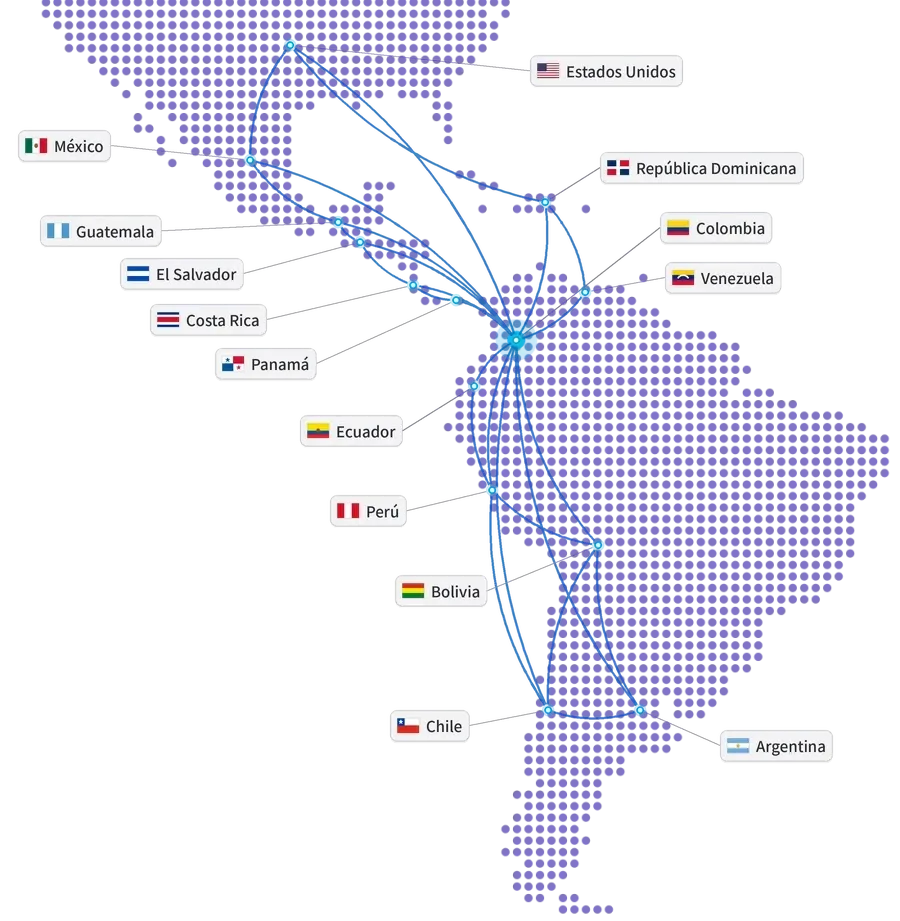
Global experience at your service
- Years of experience
- 15+
- Companies in Latin America
- 850+
- Countries
- 10+
- Integrations
- 100+
- ERP and ERP+ modules
- 40
- AI agents
- 20+
Companies that trust GIITIC






Questions about Smart Reports
What reports can the artificial intelligence agent build?
Where do the figures come from, and how do I know they’re correct?
Does the agent make forecasts or predictions?
Do I need GIITIC, or can I use my current systems?
What knowledge does it need, and who maintains it?
Who controls what the agent does?
How long does implementation take, and how much does it cost?
What happens to my analysts?
 Next step
Ready to see your agent work in your process?
Let's talk about your operation. A consultant will review your process, your systems and your knowledge, and show you how the agent would work with your rules.
- Demo of the agent with cases from your process.
- Review of your systems and the available knowledge.
- Estimate of the scope and the next step.
Let's talk about your process
Fill in your details and a consultant will get in touch with you.
Registration successful
We'll be in touch with you shortly.