
Smart Payment Application
See how cash application is evolving in organizations with AI agents.
- Prebuilt agent Ready to use, we do not start from scratch.We start from an agent prepared for this process and configure it with your rules, your systems and your way of working.
- Best practices Built in from day one.The agent's instructions incorporate the process practices we have applied when automating it in different organizations.
- Configured by experts Functional and technology consultants.Specialized consultants support the configuration, integration, testing and go-live of the agent in your operation.
- Agent platform Workforce AI.The agent runs on Workforce AI, GIITIC's own platform that centralizes security, permissions, audit, usage and administration of all your agents.
- Process experience Processes + technology + enterprise software.Behind every agent are years of experience implementing enterprise software and automating processes in companies across Latin America.
- GIITIC software ecosystem The tools the agent needs.We integrate with your current systems and, if you are missing one, the GIITIC ecosystem provides the modules the agent needs to query and act.

How it is done today, and why it is no longer enough
At many companies, most payments are still applied by hand: in a survey by Nacha and the Credit Research Foundation, more than half of cash application teams automatically processed only 0% to 20% of their payments.
- Payments without a reference
- Scattered remittances
- Manual matching
- Waits and batches
- Errors and rework
- Outdated receivables
Smart Payment Application agent

I'm an artificial intelligence agent trained by experts, ready to use and built with best practices. I am here to identify every payment you receive, find the customer and the invoices it pays —even when it arrives without a reference or with discrepancies— and apply it in your accounts receivable the same day. Anything I can’t resolve with confidence, I escalate to you with a proposal.
Prebuilt, but adaptable to each organization.
How I work
- I detectPayments receivedI read bank statements, bank transactions and payment gateway collections as soon as they arrive.
- I understandRemittance detailsI read remittances, emails, PDFs and receipts: customer, invoices, amounts and withholdings.
- I analyzeCustomer and invoicesI identify the customer even when a third party pays, and match the amount to their open invoices.
- I decideRules and tolerancesI apply your policies for partial payments, advances, discounts, withholdings and discrepancies.
- I executeApplication in receivablesI record the application in your ERP or accounts receivable system with the related supporting document.
- I verifyControl and escalationI confirm balances, keep an audit trail and escalate exceptions to you with my proposal.
Results you can achieve
- of payments matched automatically
- 70%Median for organizations using cash application software; one third exceed 80%.Source: The Hackett Group, Digital World Class Matrix: Cash Application, 2025
- apply payments the same day
- 61%Organizations with cash application solutions that apply each payment on the same day it is received.Source: The Hackett Group, Digital World Class Matrix: Cash Application, 2025
- in process cost
- −43%Reduction in the cost of the accounts receivable process (cash application, collections and disputes) with automation.Source: The Hackett Group, Digital World Class Matrix: Cash Application, 2025
- of the team freed for higher-value work
- 63%Accounts receivable staff that automation makes it possible to reassign to other activities.Source: The Hackett Group, Digital World Class Matrix: Cash Application, 2025
- automatic in leading teams
- 80%+The best-performing teams automatically process between 80% and 100% of their payments; more than half don’t exceed 20%.Source: Nacha and Credit Research Foundation, “Goofus and Gallant: Cash Application,” 2021
Reference values based on benchmarks and comparable scenarios. Results depend on the characteristics of each operation and are not guaranteed results.
Greater speed, higher quality, lower costs

Greater speed
Automate tasks and connect your information so your team responds sooner and your processes move forward without waiting.
- Applies payments the same day they are received, without waiting for the close or the next batch
- Processes the full volume without depending on team capacity
- Releases the credit limit of customers who already paid, on time
- Eliminates searching for remittances and asking customers and salespeople

Higher quality
Standardize the work and control every step so your information is reliable and your results are consistent.
- Applies every payment with the same rules, no matter who is on shift
- Interprets withholdings, discounts and partial payments according to your policies
- Keeps an audit trail of every decision: supporting document, rule applied and person responsible
- Keeps accounts receivable up to date so you don’t chase payments already received

Lower costs
Reduce rework, errors and manual work so your operation delivers more with the same resources.
- Reduces the manual effort for each payment applied
- Handles month-end peaks without overtime or temporary staff
- Cuts rework from misapplied payments and reversals
- Frees the accounts receivable team for exceptions, analysis and customer relationships
Artificial intelligence in payment reconciliation and cash application
Before
- 4:00 p.m.4:00 p.m. · MilestoneThe payment reaches the bank
- 4:00 p.m.4:00 p.m. · Lost timeEnd of the workday: the statement is reviewed the next day16 h
- 8:00 a.m. · day 28:00 a.m. · day 2 · PersonDownloads the statement and lists the day’s payments15 min
- 8:15 a.m.8:15 a.m. · Lost timeQueue of pending items2 h
- 10:15 a.m.10:15 a.m. · PersonIdentifies the customer by the name or tax ID on the transfer10 min
- 10:25 a.m.10:25 a.m. · Lost timeTeam meeting and other priorities1 h
- 11:25 a.m.11:25 a.m. · PersonSearches email for the remittance and requests it from the customer10 min
- 11:35 a.m.11:35 a.m. · Lost timeLunch, end of the workday and waiting for the customer’s reply24 h
- 11:35 a.m. · day 311:35 a.m. · day 3 · PersonMatches the amount to the invoices and explains the discrepancy15 min
- 11:50 a.m.11:50 a.m. · Lost timeLunch, break and approval from the accounts receivable manager4 h
- 3:50 p.m.3:50 p.m. · PersonRecords the application in accounts receivable5 min
- 3:55 p.m. · day 33:55 p.m. · day 3 · MilestonePayment applied
Now
- 4:00 p.m.4:00 p.m. · MilestoneThe payment reaches the bank
- 4:00 p.m.4:00 p.m. · AgentDetects the payment in the bank transaction< 1 min
- 4:01 p.m.4:01 p.m. · AgentIdentifies the customer and reads the remittance in the email< 1 min
- 4:02 p.m.4:02 p.m. · AgentMatches it to the invoices, recognizes the withholding and, since the discrepancy exceeds the tolerance, escalates it with a proposal< 1 min
- 4:03 p.m.4:03 p.m. · Lost timeThe analyst finishes their current task1 h
- 5:03 p.m.5:03 p.m. · PersonReviews the agent’s proposal and approves the discrepancy5 min
- 5:08 p.m.5:08 p.m. · AgentRecords the application and verifies the customer’s balance< 1 min
- 5:09 p.m.5:09 p.m. · MilestonePayment applied the same day
Tangible results in your operation
| Indicator | Before | Now | Factor |
|---|---|---|---|
| End-to-end cycle time | ≈ 2 days | ≈ 1 h | ×48 |
| Human work time | 55 min | 5 min | ×11 |
| Waiting time | 47 h | 1 h | ×47 |
| Human intervention | 100% | ≈ 30% | ÷3.3 |
| Team capacity | 1× | ≈ 3× | ×3 |
Illustrative reference scenario. Times depend on each operation and are validated with your data.
Your team moves from operating to deciding
The capacity the agent frees up goes to analysis, decisions, relationships, exceptions, improvement and innovation.
No more low-value manual tasks
- Downloading statements and building payment lists
- Searching for remittances in emails and portals
- Matching amounts to invoices in spreadsheets
- Keying in applications one by one
- Asking salespeople what each customer paid
The team adds value to the operation
- Resolving exceptions with the context the agent prepares
- Analyzing recurring discrepancies and deductions and their causes
- Agreeing with customers on better practices for payments and sending remittances
- Adjusting rules and tolerances to increase automatic application
- Anticipating receivables risks with up-to-date information
Your team's professional growth
- Exceptions and deductions analystResolves complex cases and recovers unjustified deductions.
- Agent supervisorReviews the quality of applications, adjusts rules and governs the agent’s knowledge.
- Credit and accounts receivable analystUses up-to-date information to make credit, collections and customer relationship decisions.
Agents are only as good as the knowledge and context they handle
It is one of the great challenges of enterprise artificial intelligence (AI): an agent without clear rules, reliable data and business context makes mistakes or stops. That is why knowledge is prepared, governed and improved as part of the project.
- Application policies and invoice priority
- Discrepancy tolerances by customer or amount
- Withholdings, discounts and credit notes

The knowledge this agent handles
- Payers, third parties and aliases for each customer
- Statement and remittance formats by bank
- Rules for advances and credit balances
60%
of AI projects without AI-ready data will be abandoned through 2026, according to Gartner. Gartner, “Lack of AI-Ready Data Puts AI Projects at Risk,” February 2025
Workforce AI helps you prepare, govern and improve it
- Instructions prebuilt by experts
- Process best practices
- Tools to create and capture knowledge
- Knowledge management
- Integration with your current sources
- Enrichment of existing knowledge
- Ongoing updates
- Knowledge governance
- Continuous learning and improvement
We integrate with your environment
We connect the agent with virtually any application, API, service or data source in your company, whether GIITIC or third-party systems.
Integrations this agent requires
- Banks and gatewaysBank statements, transactions and files; payment gateway collections.
- ERP and accounts receivable systemYour ERP (SAP, Oracle or another) or GIITIC ERP: customers, open invoices and recording the application.
- Email and portalsRemittance inboxes, customer portals and PDF or image documents.

Your agent, connected to your operation
Base systems for agents
If you do not have the base system, we provide reduced versions of GIITIC modules with the capabilities the agent needs to work.
- Treasury for agentsA reduced version of GIITIC Treasury: customers, open invoices and cash application in accounts receivable.
- Banking and reconciliation for agentsReceipt of bank statements and reconciliation of the transactions the agent applies.
- Applications and ERP
- APIs and web services
- Databases and files
- MCP (Model Context Protocol), when applicable
An agent needs software tools to query information and carry out actions. Without them, it stays a conversation. That is why we cover both paths: connecting to what you already have or giving you what you are missing.
See GIITIC integrations95%
of organizations struggle to integrate AI into their existing processes. MuleSoft (Salesforce), Connectivity Benchmark Report 2025, study sponsored with Vanson Bourne and Deloitte Digital
Today it is one agent, tomorrow dozens
Every area will add agents working at the same time. Workforce AI is the control center of your digital workforce, not an isolated script.
Explore Workforce AI- Agent creation and management
- Security, identities and permissions
- Policies and human oversight
- Traceability and audit
- Observability, quality and results
- Models, tokens, usage and costs
- Continuous updates to new AI models and features
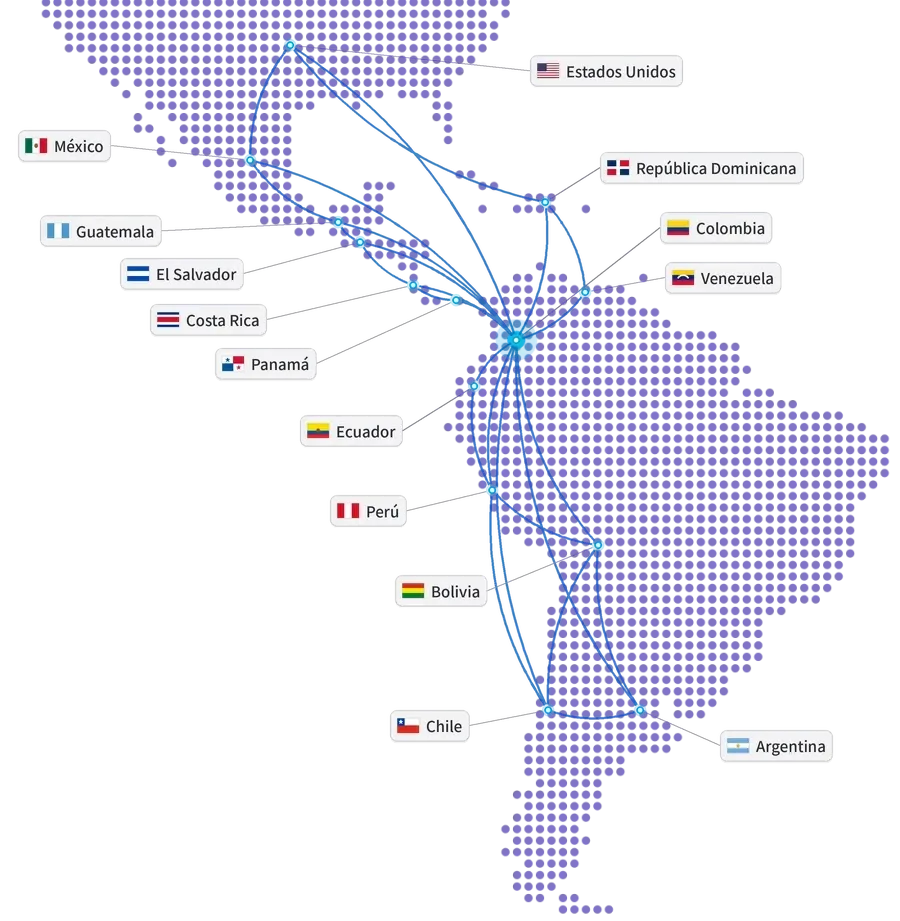
Global experience at your service
- Years of experience
- 15+
- Companies in Latin America
- 850+
- Countries
- 10+
- Integrations
- 100+
- ERP and ERP+ modules
- 40
- AI agents
- 20+
Companies that trust GIITIC






Questions about Smart Payment Application
Which payments can the artificial intelligence agent apply?
What happens when it can’t identify a payment or there is a discrepancy?
Do I need GIITIC ERP?
How does it adapt to my accounts receivable policies?
What knowledge does it need, and who maintains it?
Who controls what the agent does?
How long does implementation take, and how much does it cost?
What happens to my accounts receivable team?
 Next step
Ready to see your agent work in your process?
Let's talk about your operation. A consultant will review your process, your systems and your knowledge, and show you how the agent would work with your rules.
- Demo of the agent with cases from your process.
- Review of your systems and the available knowledge.
- Estimate of the scope and the next step.
Let's talk about your process
Fill in your details and a consultant will get in touch with you.
Registration successful
We'll be in touch with you shortly.